Watch the MAVEN Launch With Me: Monday at 10am Pacific

Hey everyone, I’ll be live-Google-Hangouting from the MAVEN launch (next mission to Mars) in Florida on Monday morning (November 18th. The launch is at about 10:20 Pacific Time, so tune in around 10am.). That’s right, you get me as an on-location reporter for this launch for the first time ever … I’ve never been to a real in-person launch before. I’ll be watching from the Causeway.

I’ll be co-hosting with Shannon Hall and Sarah Culp, who will be Hangouting from Pacific Science Center. Turn on NASA TV in one browser, and join our Hangout in another. Can’t wait to see you! I’ll be posting links here as I get them, and if all else fails check in on my Twitter and Pacific Science Center’s Twitter to get the full scoop that morning!

You can also join Shannon and Sarah in person at Pacific Science Center, details to follow later this afternoon.


Edit to add: You can listen to my interview on KOMO about the MAVEN launch if you missed this hangout or the interview on the actual day of launch.

~ A l i c e !

Mars Rover Rocker-Bogie Differential

Today’s is a guest post, brought to you by my father, engineer, physicist, computer programmer, and Lego, Mars, and animation enthusiast: Keith Enevoldsen. If you’re not caught by the title of the post, scroll down and look at the pictures… then scroll back up and read the rest of the article because it is fascinating stuff! (P.S. He has a website full of awesome science stuff too!)
A teaser for what you have to look forward to…

~ A l i c e !

The Rocker-Bogie

All the Mars rovers have six wheels and use a rocker-bogie suspension system to drive smoothly over bumpy ground. The rocker-bogies are easy to see in pictures of the rovers (see pictures below). There is one rocker-bogie assembly on each side of the rover. The rocker is the larger link that connects to the rover body (the chassis) in the middle (at the rocker pivot), has a wheel on the front, and connects to the bogie in the back. The bogie is the smaller link that connects to the rocker in the middle (at the bogie pivot), and has wheels at both ends. Each of the six wheels has its own motor.

The Differential

It is not so easy to see and understand how the rocker-bogie mechanism keeps the body level. What prevents the rover body from tipping all the way forward or backward around the rocker pivots? If you build a model rover and you attach the rockers to the body with an axle or two pivot pins, the body will tip forward or backward until it hits the ground! In the real rovers the two rockers connect to each other and to the body through a mechanism called a differential. The differential is what keeps the body level. Relative to the body, when one rocker goes up, the other rocker goes down. Relative to the ground, the body angle is halfway between the angles of the two rockers. That’s cool, but how does it work? The different rovers use different mechanisms: a differential gearbox or a differential bar.

Differential Gearbox

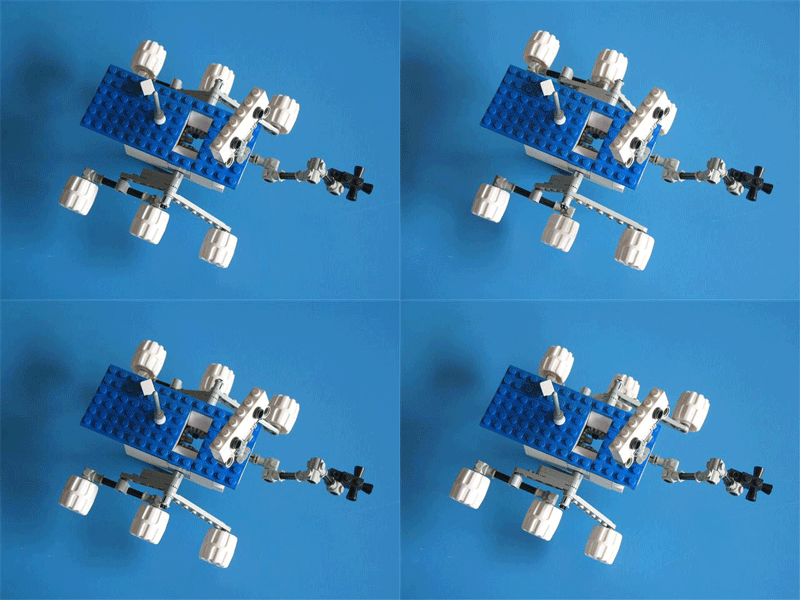
The Mars Pathfinder (Sojourner) and Mars Exploration Rovers (Spirit and Opportunity) use differential gearboxes.
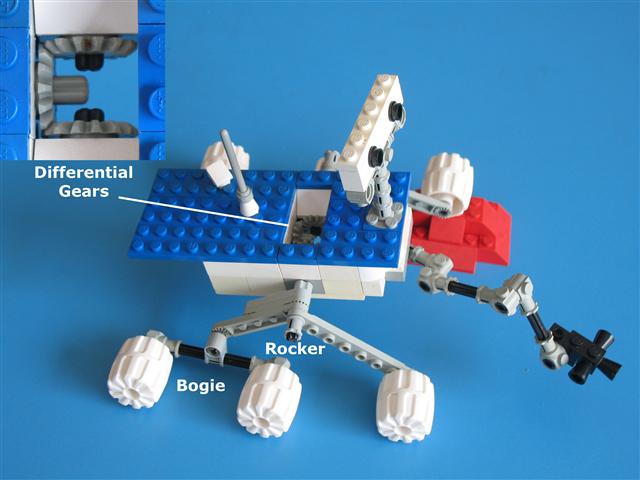
MER’s Differential
Image and Model © 2012 Keith Enevoldsen

The gearbox is inside the rover body, so you never see it. No wonder it is hard to figure out how it works! In my Lego model rover shown here, I use a simple three-gear differential. Two gears connect to the two rockers and the third (middle) gear connects to the body. If you hold the model rover body steady in midair and tilt one rocker up, the gears will turn and the other rocker will tilt down (see the animations below).

The real Mars Exploration Rovers use more complicated gearboxes with more gears but they are functionally equivalent to this simple three-gear differential.

Differential Bar

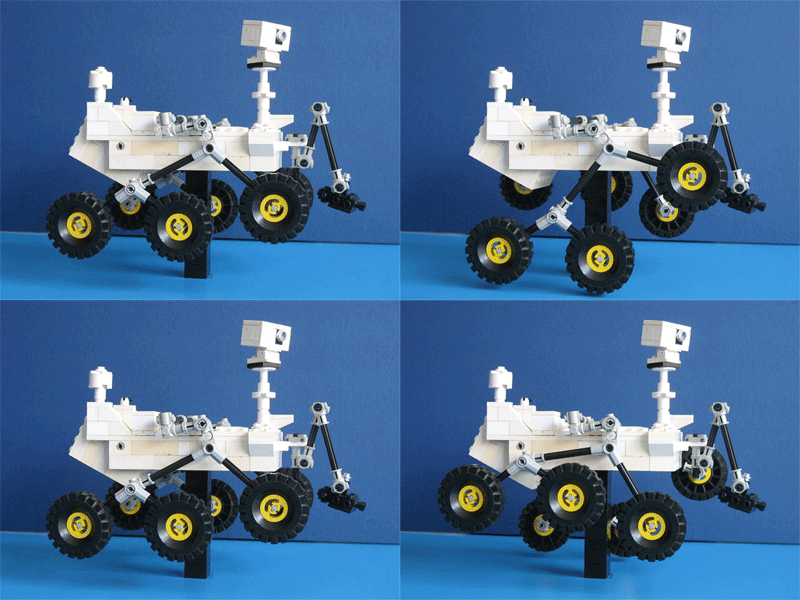
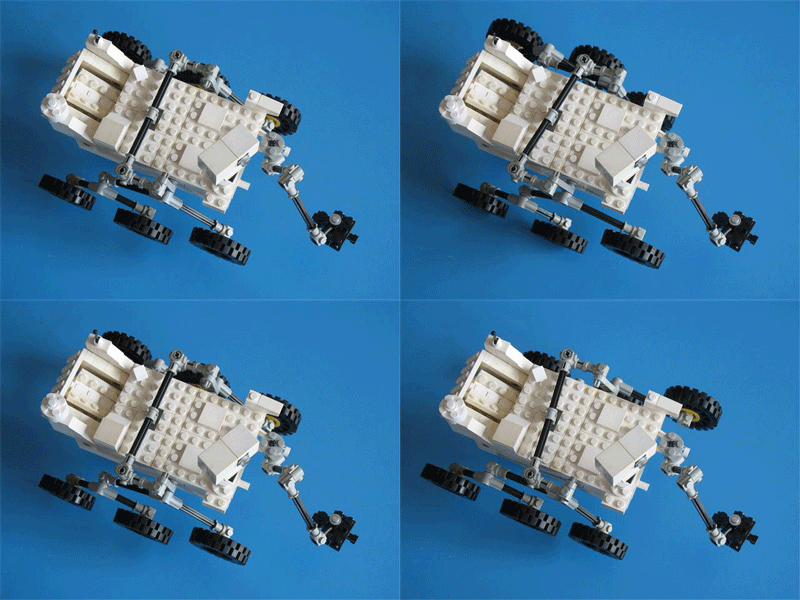
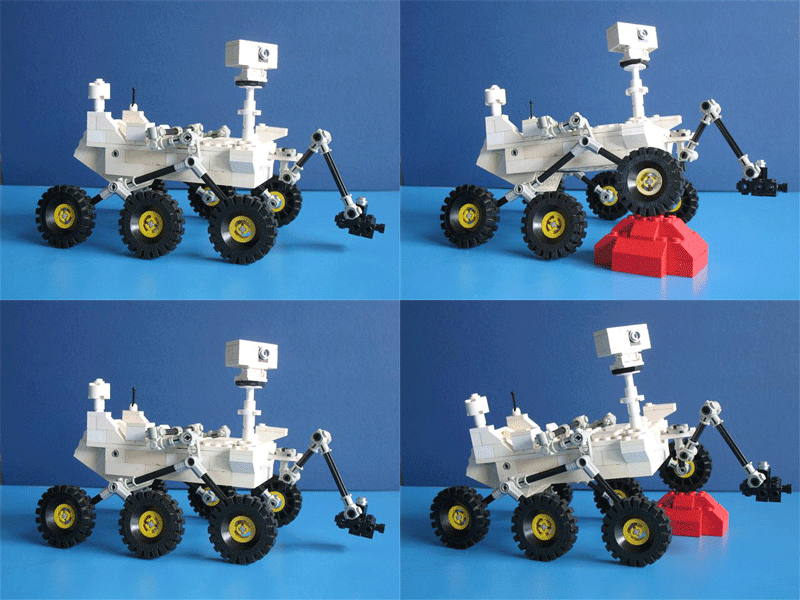
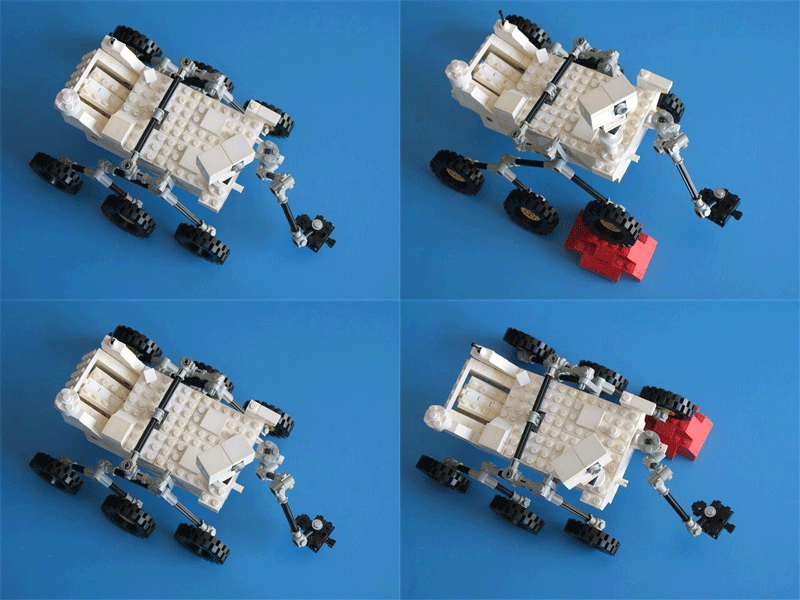
The Mars Science Laboratory (Curiosity) uses a differential bar. This is the big black bar that you see across the deck of the rover.
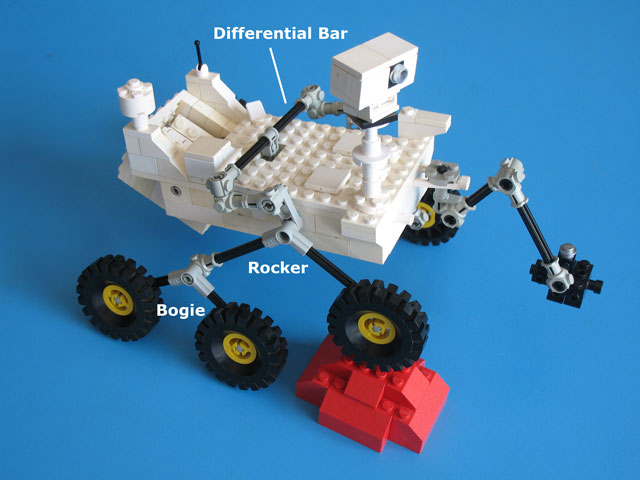
Curiosity’s Differential
Image and Model © 2012 Keith Enevoldsen

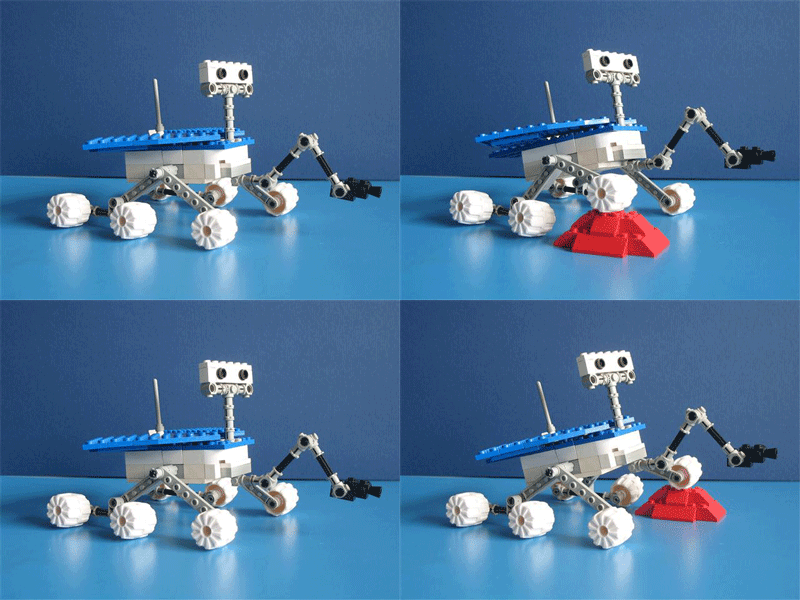
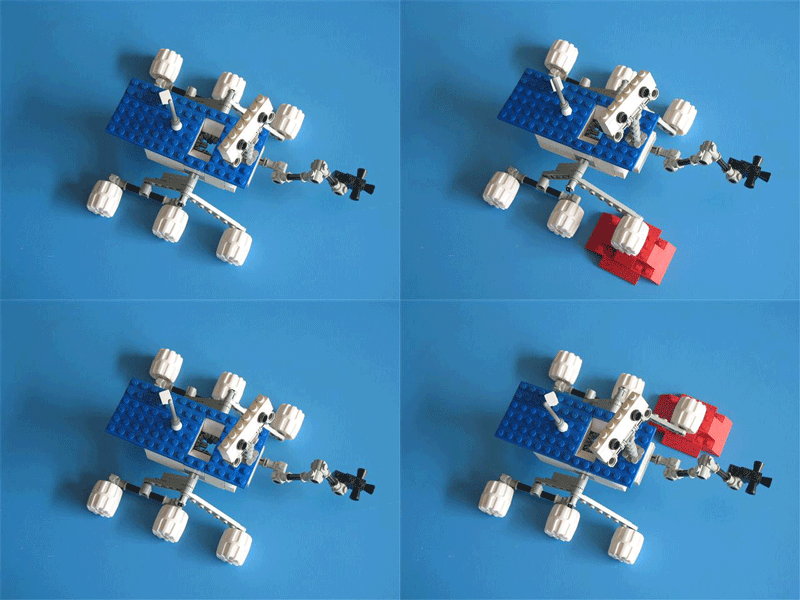
The middle of the bar is connected to the body with a pivot and the two ends are connected to the two rockers through some short links. If you hold the model rover body steady in midair and tilt one rocker up, one end of the bar will go back, the other end will go forward, and the other rocker will tilt down (see the animations below).

The Mars Exploration Rovers did not use a differential bar because it would interfere with the solar panels. But the Mars Science Laboratory does not have that problem because it is nuclear powered and has no solar panels.

Animations

Animations of a Rocker-Bogie with a Differential Gearbox

Mars Exploration Rover (Spirit and Opportunity)

Body held steady in midair:
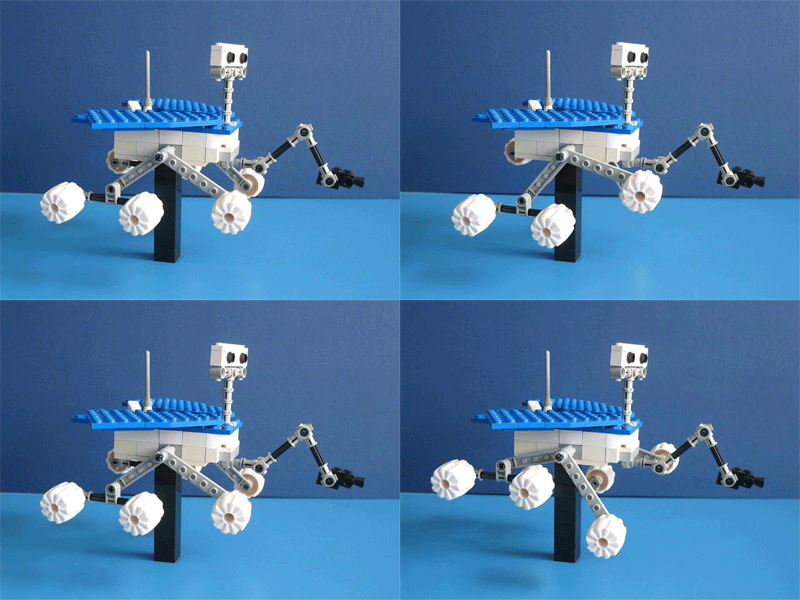
 

Wheels on the ground:
 

Animations of a Rocker-Bogie with a Differential Bar

Mars Science Laboratory (Curiosity)
Body held steady in midair:

Wheels on the ground:
 

No Springs

The rocker-bogie mechanism has no springs. The absence of springs helps it keep all six wheels on the ground with approximately equal pressure on each wheel. This is a good thing when you are driving on sand!

Want More? (and References)

“Mars Exploration Rover Mobility Assembly Design, Test and Performance”, JPL

“A Capable and Temporary Test Facility on a Shoestring Budget: The MSL Touchdown Test Facility”, JPL


I hope you enjoyed my dad’s post. He sure had fun figuring out those mechanisms and creating them out of Lego!

I’ll be posting a Curiosity-landing-“watching” event here very soon.

~ A l i c e !

Magnetotactic Bacteria from Mars?

I read the papers. No, I mean the peer-reviewed scientific papers. The upshot is this. In 1984 we discovered a meteorite in Antarctica and proved it was from Mars. In 1996 a group of scientists released a paper claiming that there might be evidence for life in that meteorite, most famously in the form of  “fossils of bacteria” (I’ll get more technical on that later). It didn’t take long for other scientists to come up with a series of other possible sources for the markers that the first group were claiming as markers of life. Although the work continues, for the last 13 years it has been widely accepted by the public and by many scientists that the markers in the meteorite (ALH 84001) were not formed by bacteria, they were formed by “plain old  geology”. No life.

Well, last week that changed (as new science is wont to do). A group of scientists has been looking closer (literally, they’re using better electron microscopes than we had in 1996) at ALH 84001 for the last 13 years, and last month they published a paper claiming that the suggested geologic processes could not have made the formations found in the meteorite. In other words they disproved the disproof of their original hypothesis, which was that there was once life in this rock. Now, and this is very important to note, they do not claim to have found proof of life, or to have found indications of life. They simply claim that the possibility of a “biogenic origin” is once more back on the table. (Last update: 12/1/2009)

Magnetotactic Bacteria from NASA Johnson Space Center

Magnetotactic Bacteria from NASA Johnson Space Center

Carbonates and Magnetotactic Bacteria

Explaining magnetotactic bacteria would overwhelm this AstroInfo, so I’ll save that for next time. Suffice it to say, there are bacteria that create very pure nano-scale (really-über-tiny) magnetite. When Kathie (K.L. Thomas-Keprta, primary author) and her team examined the magnetite in ALH84001 they found it identical to the magnetites created on Earth by magnetotactic bacteria. Most importantly – it was extremely pure. This magnetite was associate with carbonate grains in the meteorite, and carbonate is an indication of water. If the magnetite had formed from or with the carbonate it wouldn’t have been as pure as it is.

I look forward to reading any rebuttals put forward by scientists who do not see this as evidence of possible ancient bacteria on Mars.

Where’d I Get My Info?

Press Release
Paper 1: Origins of magnetite nanocrystals in Martian meteorite ALH84001 (Peer-Reviewed)
Paper 2: Life on Mars: New Evidence from Martian Meteorites (Invited Paper)
Magnetotactic Bacteria

~ A l i c e !

Snow Falling on … Mars

The Main Idea:

The Phoenix Mars Lander’s weather instrument (a LIDAR – like radar, only with a laser) detected snow falling from clouds above the Phoenix Lander on 9/29/2008. The snow sublimed before it hit the ground, but we’re in Seattle, we’re used to celebrating snow that doesn’t hit the ground.

More?

I know, I’m sorry, I’m really late posting this. But this is a “Mars has Water!!” discovery that I actually think merits some kerfuffle (of the last eight I think there have been about two of discoveries that do).

So here’s the thing – we’ve known for since forever that there is ice on Mars (though we verified it in 1970), and in 2006 we saw evidence of water that had actually been flowing within the last year. All the other announcements are varying levels of confirmation of these facts. For instance just a month or two ago, Phoenix watched ice subliming. Before that, the various rovers and landers have imaged clouds (that include H2O) in Mars’s atmosphere.

This is DIFFERENT. This is the missing section of the water cycle – not water on the surface, not water evaporating or subliming, not water in clouds, but water falling back down again!

So, if that closed the water cycle what are we still waiting to find? We still want to see liquid water, and I wouldn’t mind seeing some of that falling snow actually hit the ground, but I’m not going to hold my breath for that one.

More Posts About the Snow:

Bad Astronomy: Snow Place like Mars
Universe Today: Snow is Falling From Martian Clouds
Martian Chronicles: Phoenix Sees Snow and Carbonates on Mars!

The Press Release:

NASA Mars Lander sees Falling Snow

Mars Has Water – Yes, Again

Yup. Phoenix found water. For sure. Yup.

A complete table of the multiplicitous discoveries of water on Mars: my post from 2006.

The cool thing about this discovery, as compared to all the rest? We’ve actually picked up and touched this water. We are absolutely certain that it’s water. Very awesome, but not new news.

Ice on Mars! Umm… duh…

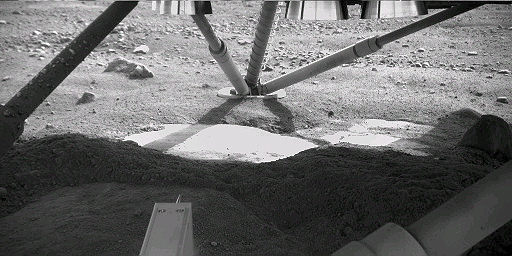
So, Phoenix found some ice on Mars. Yay! Here’s JPL’s picture:

2008_06_02 Ice Under Phoenixl

Credit: NASA/JPL-Caltech//University of Arizona/Max Planck Institute

So, this is great, but I’m not gasping with shock, or even amazed. This was expected. Also, this is not the first time we’ve found water or ice on Mars. Let me recap an old AstroInfo for you that explains exactly how many times we’ve “discovered” water on Mars.

My post from 2006. Contains a complete table of the multiplicitous discoveries of water on Mars.

Added 6/2/2008: And now we’re sitting on ice. This is wonderful, this is exactly where Phoenix wanted to be. They want to study ice, because ice is water, and water is necessary for life as we know it. By analyzing the ice, they’ll be able to work on both of their primary objectives: “Study the History of Water in All its Phases“, and “Search for Evidence of Habitable Zone and Asses the Biological Potential of the Ice-Soil Boundary”

Good for them, but remember, it’s not the first time we’ve found water on Mars.

Some Sources:

Emily Lakdawalla’s Interpretation: http://www.planetary.org/blog/article/00001485/
The Press Release: http://www.jpl.nasa.gov/news/news.cfm?release=release=2008-090b

Mars Has Water …

“Mars Has Water!” News Releases

This table is updated often. The latest update is the date of the latest news release.

Date News Released News Title, Mission, Evidence Reliability of Evidence Amount of Water Date the Water May Have Been Liquid
September 24, 2009 Scientists See Water Ice in Fresh Meteorite Craters on Mars, HiRISE Camera on Mars Reconnaissance Orbiter, images and change in images over time. Very pure water ice found at mid-low latitudes on Mars was kicked up (excavated) when a meteor hit Mars creating a crater. This ice disappeared quickly over the course of the summer. Medium Small A long time ago. The ice probably sublimed rather than melting.
September 29, 2008 NASA Mars Lander Sees Falling Snow, Soil Data Suggest Liquid Past, MET on Phoenix, LIDAR data on polar clouds Medium Small Ice crystals that sublimed before hitting the surface
September 24, 2008 Evidence of Rain on Mars, HRSC on Express, MOC on Global Surveyor, HiRISE and CTX on MRO, Photograph of river channels and other water-eroded surface features Medium Medium 3.5-3.8 Billion Years Ago
July 31, 2008 NASA Spacecraft Confirms Martian Water, Mission Extended, Phoenix Lander, Direct Sampling and Gas Analysis Extremely High Small Well, we melted it in TEGA, but other than that, unknown
May 30, 2008 NASA’s Phoenix Lander Robotic Arm Camera Sees Possible Ice, Phoenix Lander, Photograph of Ice followed by Photograph of Presumed Ice Sublimation Medium Small Unknown
Dec. 6, 2006 NASA Images Suggest Water Still Flows in Brief Spurts on Mars, Mars Global Surveyor, Formation of new gullies in crater walls High Small Between 1999 and 2005
May 28, 2002 (2001?) Found it! Ice on Mars, Mars Odyssey, Large Amounts of Subsurface Hydrogen Low Large Unknown: millions of years ago.
June 22, 2000 Mars Surprise, Mars Global Surveyor, Old Gullies High Small In the last million years or last 100 years.
1999 Water on Mars: Not So Ancient, After All, Mars Global Surveyor, Large-Scale Landforms Possibly Created by Water Medium Medium In the last 10 million years
1970s North Pole Has Some Water Ice as well as Dry CO2 Ice, Mariner 9 and Earth-Based Observations, Spectrographic and Infrared Analysis Medium Very Small Unknown: millions of years ago.
Laugh Out Loud Cats - Mars Has Ice! - Courtesy Adam Koford

Laugh Out Loud Cats - Mars Has Ice! - Adam Koford

From December 8, 2006

The Mars Global Surveyor, a satellite that has been in orbit around Mars since 1997, sent back a picture containing evidence that water flowed on Mars sometime during the last five years. These pictures were released by NASA on December 6, 2006, though the photos were taken in 2004 and 2005.

The evidence shows new deposits within a crater that look like they were left by flowing water. Simple enough evidence, so let me answer a few specific questions about this story.

How come we’re just hearing about this now?

As of November 2006 the Mars Global Surveyor stopped responding to NASA Control (it had a lifetime of 9 years – 7 years longer than expected). The pictures containing the evidence were taken and sent to Earth in 2004 and 2005. As with most NASA missions, we get more data back than we can possibly sift through as fast the satellites send it to us. To tell you the truth, they’re still sorting through some of the data from the 1996 Pathfinder mission to Mars (the first rover). Expect to hear more discoveries from the Mars Global Surveyor in the future, even though the satellite itself is now defunct.

Background Knowledge: Erosion and Deposition

Okay, time for a quick geology/planetology class. Do you remember the vocabulary words sediment, erosion, and deposition from some science class you had? As water flows it picks up (erosion) bits of dirt and whatever else is on the surface (sediments). When the water slows down it drops those sediments (deposition).

Water is the best eroder we know. Wind can erode too, but not nearly as effectively, and wouldn’t leave sediments in the same patterns as water. That’s why we’re excited by these new photos: the deposits look like they were left by water.

Why is this important?

Life as we know it needs liquid water. Life is cool.

Is this news?

“Wait,” I hear you saying, “Didn’t this news come out several years ago? And then didn’t we hear it again a couple of years ago? What’s with this?”

You’re right: this is the fourth (or maybe fifth) reliable announcement in recent history that “Mars has water.” The difference between all these announcements is the strength of the evidence, the amount of water found, and the estimated date that the water was liquid.

In the 1970s, we observed the light bouncing off Mars’s ice caps, and determined that they contained at least some water, though they were mostly frozen carbon dioxide (dry ice). Two decades later, in 1999, we were able to look at photos of the surface of Mars that showed outlines of riverbeds, floodplains, and smooth surfaces: all evidence of “recent” water activity. In this case, “recent” means geologically speaking: within several million years. In the year 2000, scientists received pictures of gullies carved by water: gullies that could have easily been formed within the last 100 years. Or, they could have been formed a million years ago, since we haven’t observed much erosion on Mars.

More recently, in 2001 (2002?), scientists detected large amounts of underground hydrogen. Since water is H2O (two hydrogens and an oxygen), underground hydrogen indicates the possibility of large deposits of water. Other evidence tells us that this water would be frozen, if it’s actually there.

Two days ago we got new news. Between the time that we took a picture of a few certain crater walls in 1999, and the most recent pictures of the same craters from 2004 and 2005, new dirt (the fancy word for dirt on another planet is regolith) had been deposited.

Want More?

Water Precipitation on Mars

NASA’s Mars Pages

Where’d I Get My Info?

Mars Global Surveyor

Press Release

Press Release

Space Science